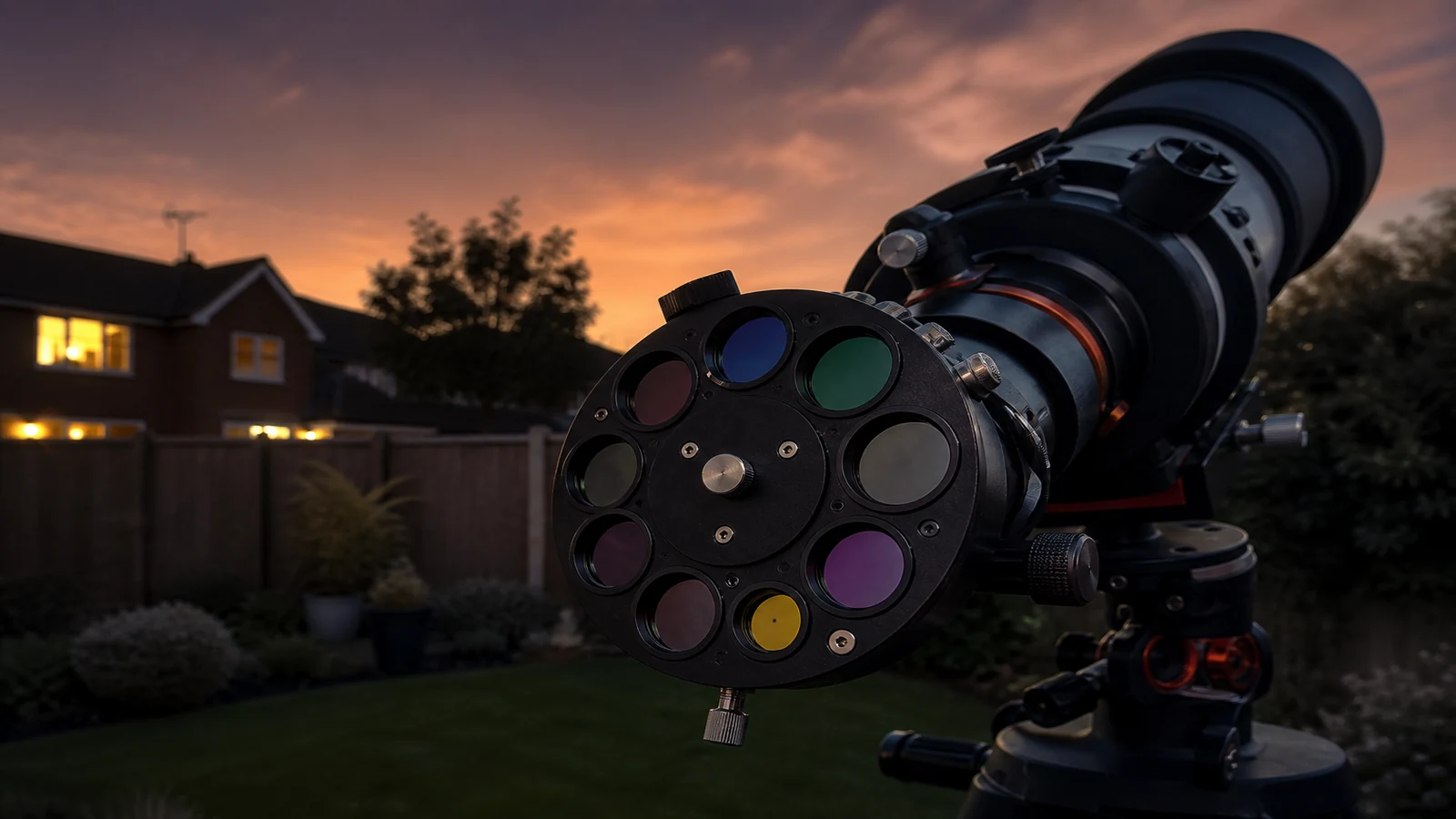
Bortle 6 7 backyard nine slot filter layout UK: rotation map
If you observe from a typical UK suburban garden, you are probably somewhere around Bortle 6 or 7 on clear nights. Light pollution washes out faint nebulae, yet narrowband filters can still pull contrast from emission targets when you compare slots quickly. A nine-position manual wheel lets you pre-load filters once and rotate through UHC, O-III and planetary colours without unscrewing glass in the dark.
Bortle 6–7 reality in UK gardens
Emission nebulae such as M42 and M8 respond to narrowband slots more often than open clusters or galaxies. Globulars and galaxy groups usually look better through an empty slot or a mild contrast filter, not a heavy UHC. LED street lighting has replaced older sodium in many UK streets, which can make broadband skyglow filters less helpful on some targets while O-III and UHC still isolate nebula lines.
- Spring and summer: planetary nebulae and bright H-II regions in Cygnus and Sagittarius.
- Autumn: Andromeda and Perseus clusters—often unfiltered or lightly filtered.
- Winter: Orion nebula and Rosette—prime UHC and O-III comparison nights.
Seasonal target table for wheel positions
Think of the wheel as a rotation map, not a rigid prescription. Slot 1 might hold UHC for diffuse nebulae; slot 2 O-III for planetaries; slot 3 H-beta for the Horsehead region on larger apertures; slot 4 a moon or ND filter when the Moon is up; slot 5 a mild contrast or neodymium filter for Jupiter; slots 6–8 Wratten colours for Saturn and Jupiter detail; slot 9 blank for side-by-side checks against filtered views.
Example nine-slot layout
One practical layout for a growing visual collection: UHC, O-III, H-beta, moon/ND, Baader neodymium or CLS, #8 yellow, #58 green, #82A blue, blank. Adjust to the filters you actually own—nine slots does not mean you must fill every position on night one.
LED street-light caveat
Narrowband slots still help many emission targets under moderate pollution, but no filter replaces a dark rural site. Treat filter gains as heuristics: some nights UHC wins on M42, other nights O-III pops more on M57. The wheel exists so you can test both without recentring the eyepiece.
Session workflow on the wheel
Find the target unfiltered using the blank slot. Rotate to UHC, note contrast and star count. Click to O-III on the same field. Log which slot wins before moving to the next object. The manual 9-position 1.25-inch filter wheel on this site uses tactile click-stops so each position aligns without a torch.
When not to use narrowband slots
Do not expect UHC or O-III to rescue globular clusters or galaxy groups—they often dim the view without adding structure. For those targets, leave the blank slot or use a very light contrast filter only if you already know it helps your scope.
If a nine-slot manual wheel matches how you observe from a Bortle 6–7 garden, review the current specification on the 9-position telescope filter wheel product page.
Do I need nine filters on day one?
No. Start with UHC, O-III and a blank slot, then grow into planetary colours as your collection expands.
Will this layout work on every UK target?
No. Filter chemistry and your aperture change outcomes—use the layout as a starting map, not a guarantee.