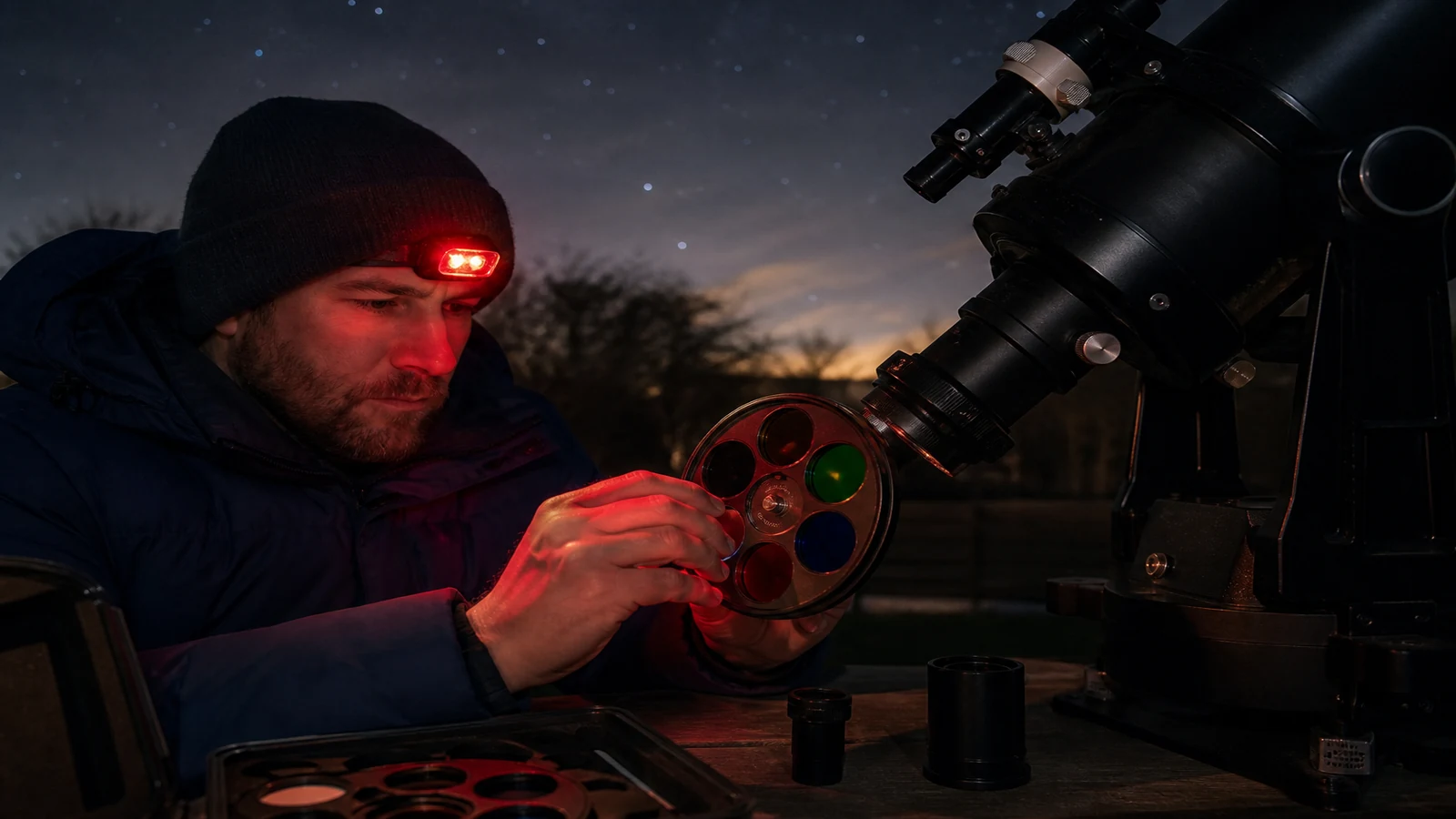
Is a filter wheel worth it for visual astronomy UK? Decision guide
A filter wheel is worth buying when you change filters more than a few times per session or want quick A/B comparisons without removing the eyepiece. For UK visual observers who already own three or more mounted 1.25-inch filters, a manual wheel often saves time on cold, dewy nights. If you only use a moon filter twice a year, screw-on filters remain the simpler choice.
Direct answer for visual observers
The value is speed and consistency. Rotating a indexed wheel with click-stops beats threading filters in the dark when you hop between Jupiter colour filters, a moon ND slot, and nebula narrowband on the same evening. Imaging rigs benefit too, but this guide focuses on eyepiece-side visual swaps.
UK pain points: cold fingers and lost dark adaptation
Suburban sessions in Britain mean gloves, damp grass, and white-light torches if you drop a filter cap. Each screw-on swap risks recentring the target after you re-find the field. Observers on forums often describe wheels as worthwhile when frequent swaps become tedious, yet an unnecessary luxury if filters rarely leave the case.
Decision table by session type
- Lunar-only nights: wheel helps only if you rotate moon ND and colour filters on planets later.
- Planetary evenings: strong case when you use three or more Wratten colours per planet.
- Deep-sky from the garden: strong case when comparing UHC and O-III on the same nebula.
- Small refractors: check back focus—this site's wheel consumes about 22.5 mm.
Who should skip a wheel
Skip it if you own one moon filter, use a nebula filter twice a season, or your focuser has almost no inward travel. Also skip if you prefer picking filters slowly at a warm table and accept one filter per target.
Practical checklist before buying
Count how many filter changes you make on a typical night. Run one session with manual screw-on swaps and note recentring time. Measure focuser travel with your longest eyepiece chain. If swaps exceed five per hour or you lose targets after threading filters, a wheel likely pays back.
Five-slot vs nine-slot growth path
Five slots suit a compact set: UHC, O-III, moon, two planetary colours. Nine slots let you load a full planetary palette plus narrowband and still keep a blank comparison position. The manual 9-position 1.25-inch filter wheel listed here holds standard mounted filters with T2 threads on both sides for rigid connection to focuser and eyepiece adapters.
If frequent filter swaps match your UK observing style, read the live price and specification on the 9-position telescope filter wheel product page.
Does a wheel replace careful filter storage?
No. Caps and a dry case still matter when filters are out of the wheel for cleaning.
Is a motorized wheel required for visual use?
No. Manual click-stop wheels suit visual rotation without cables or driver software.