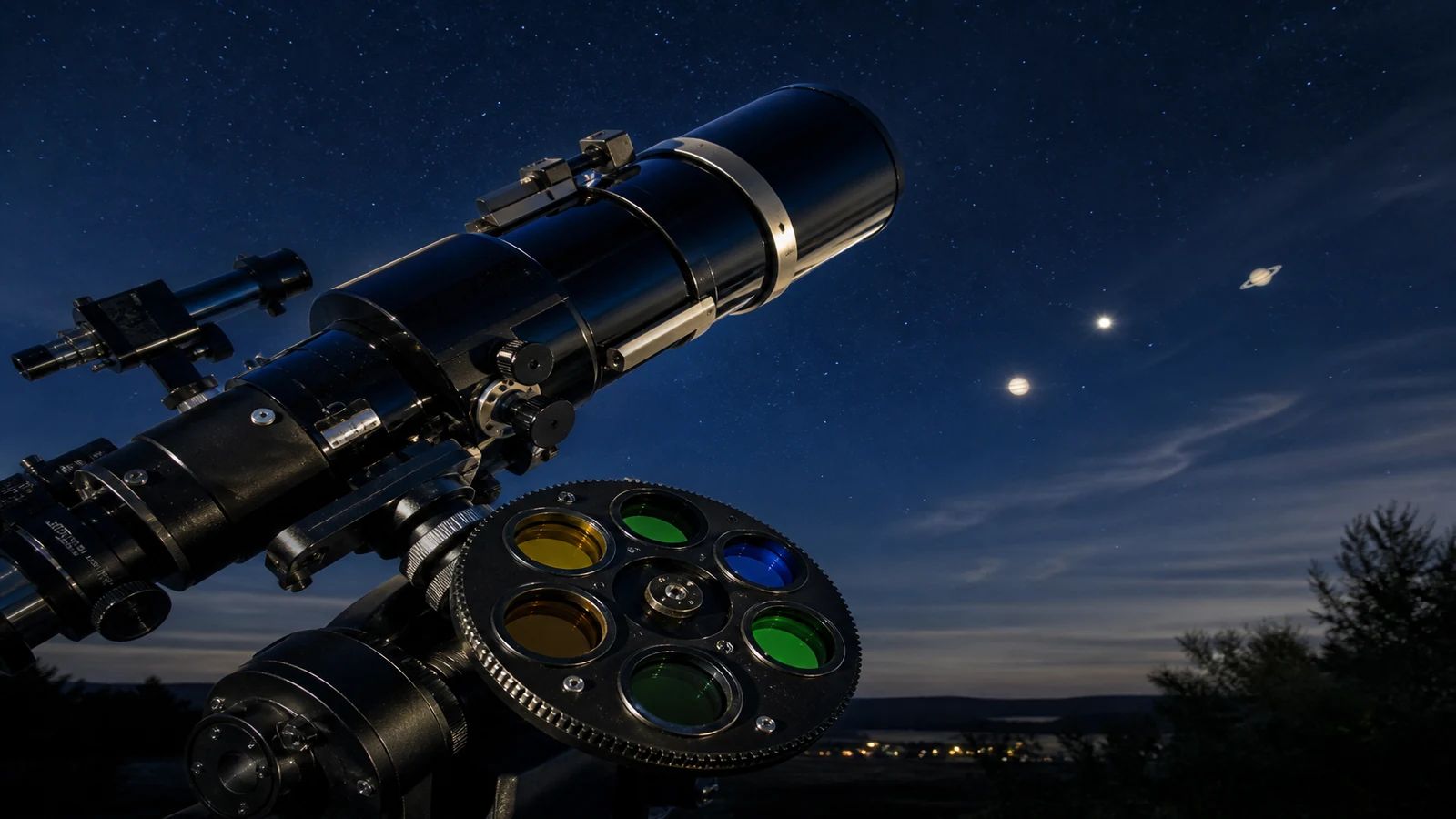
Jupiter Saturn colour filters nine position wheel order UK
Planetary evenings in the UK often mean mediocre seeing and limited clear time. Loading Jupiter and Saturn colour filters once into a nine-position wheel lets you rotate through yellow, green and blue slots without unscrewing glass while the planet drifts. Combine colour slots with a moon or ND position when the Moon shares the sky.
Why planetary nights waste time on swaps
A typical visual run might use a light yellow for Jupiter belts, a green for Saturn ring contrast, and a darker blue for the Great Red Spot on larger apertures. Screw-on changes force you to refocus and recentre. A indexed wheel keeps the eyepiece path fixed while you click through candidates.
BAA-friendly colour starting points
The British Astronomical Association notes W8 yellow as a useful all-round Jupiter filter and W58 green for Saturn belt contrast during visual study. Sky at Night guides often mention dark blue filters for belt detail on Jupiter when aperture and seeing allow. Treat these as starting points—your eye and telescope combination may prefer slightly different Wratten numbers.
Suggested nine-slot map
One workable load order: moon or ND, #8 yellow, #12 yellow-green, #21 orange, #58 green, #80A blue, #82A light blue, blank for unfiltered checks, plus one slot for a mild skyglow or neodymium filter if you split the night between planets and nebulae. Reorder to match the filters in your case.
Aperture guardrails for UK scopes
On 80–114 mm refractors, lighter yellows and greens often suffice; very dark blues can dim the image excessively. From 150 mm and up, darker blues may help GRS and ring Cassini division attempts on steady nights—still rare under UK seeing. Log which slot worked after each session rather than assuming one colour wins every opposition.
Session flow on the wheel
Start on the blank slot to judge seeing. Rotate to your best yellow for Jupiter belts, then try green if belts look soft. For Saturn, compare green against a light blue on the same magnification. The manual 9-position filter wheel on this site uses mechanical click-stops so you can change slots by feel with gloved hands.
FAQ on stacking and threading
Do not stack multiple filters in one wheel position unless the cell is designed for it—extra glass can vignette small scopes. Eyepiece-threaded filters still work for observers who own only one planetary colour; the wheel pays off when you rotate among several each hour.
If you want a nine-slot changer for planetary nights, check dimensions and price on the 9-position telescope filter wheel product page.
Will I see the Great Red Spot every night?
No. UK seeing and GRS rotation mean some sessions show little detail even with the right filter.
Can I use the same slots for deep-sky later?
Yes, but many observers reload narrowband filters when switching from planetary to nebula targets.