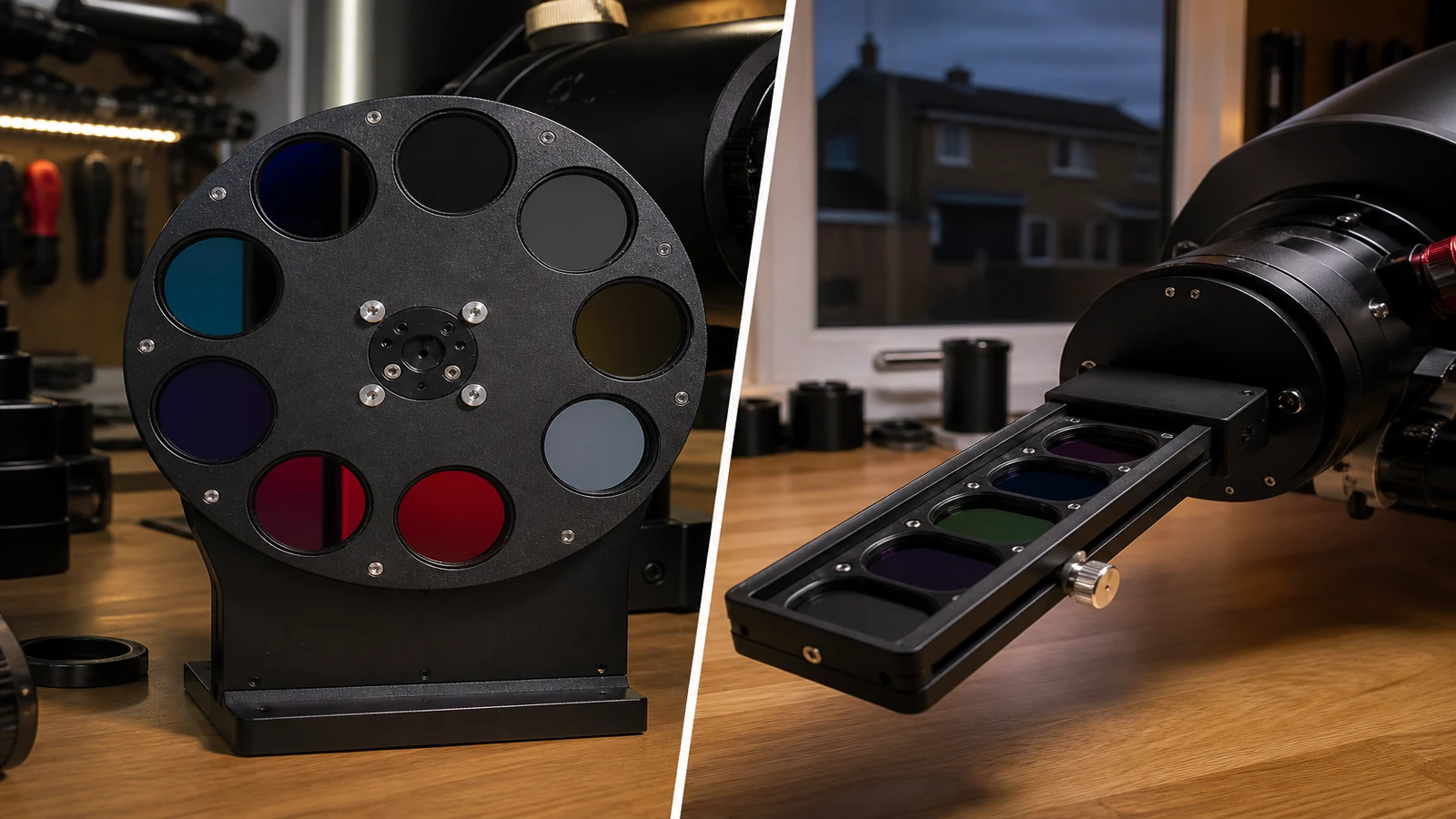
Manual filter wheel vs filter drawer visual astronomy UK
Visual observers choosing a 1.25-inch swap system usually compare a rotating indexed wheel against a sliding filter drawer or quick changer. Wheels excel when you compare many filters on one target; drawers can sit lower in the optical train when back focus is tight. Neither replaces good filter caps and a dry storage case.
Define wheel and drawer systems
A manual filter wheel holds several mounted filters in a carousel. You rotate to a numbered position with click-stops aligned to the optical axis. A drawer or quick changer inserts one filter at a time into the light path, often with a sliding or lever mechanism marketed for low profile.
Speed and side-by-side comparisons
Wheels win when you want UHC versus O-III versus blank on the same nebula within minutes. Drawers can be fast for single swaps but slower when cycling three or more filters repeatedly. For planetary colour tests, wheels keep the eyepiece fixed while you rotate yellow, green and blue slots.
Dust, storage and handling
Wheels keep filters mounted inside a closed housing between sessions—useful on dewy UK lawns. Drawers require discipline: filters out of the light path need caps and a tray, not an open pocket. Both systems beat leaving threaded filters on the grass while you hunt the next eyepiece.
Visual vs imaging bias
Drawers are often marketed to imagers who need minimal back focus for camera spacing. Visual observers with comfortable focuser travel may prefer a wheel's indexed rotation. The nine-slot wheel on this site lists about 22.5 mm back focus consumed—compare that against your focuser inward range before ordering.
Decision checklist
- How many filters do you use per session—three or eight?
- Do you need a blank slot for unfiltered comparison?
- Will gloved operation matter on winter nights?
- Is focuser travel limited on a compact refractor?
When to keep screw-on filters
Occasional moon-filter users and observers with one nebula filter may not gain enough time to justify either system. Screw-on cells remain valid when swaps are rare and back focus is already critical.
If a manual nine-slot wheel fits your visual workflow better than a drawer, review the specification on the 9-position telescope filter wheel product page.
Are drawers always lower profile?
Not universally—model depth varies. Measure your train before assuming either option fits.
Can imagers use the same wheel as visual setups?
Yes, when T2 spacing and back focus suit your camera adapter chain.