UHC vs OIII filter which targets filter wheel UK
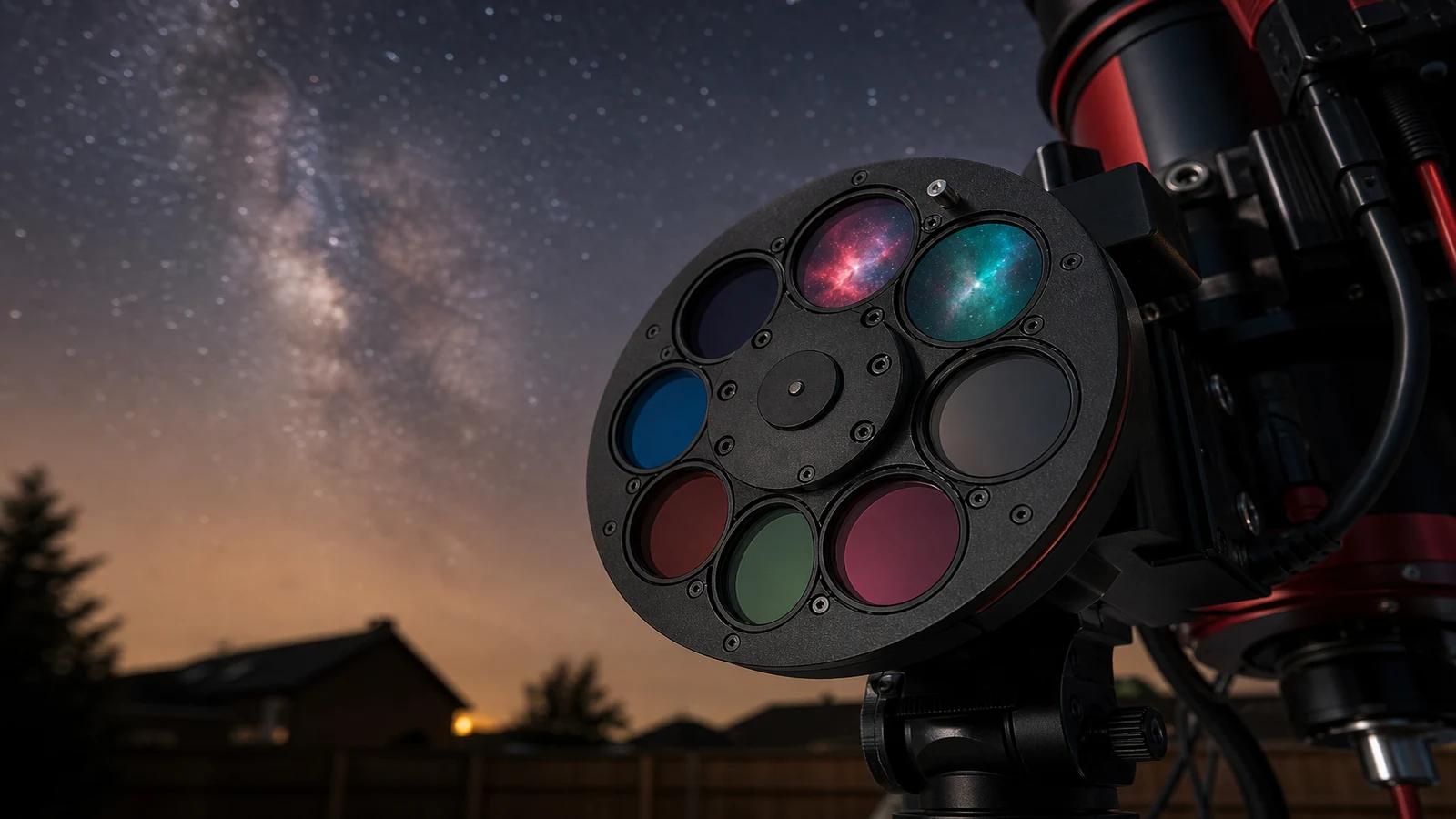
UHC-type filters pass broader emission bands including O-III and H-beta regions, making them a flexible first choice on many nebulae. O-III isolates oxygen lines and often wins on planetaries and sections of the Veil. Loading both on a manual wheel lets you test each on the same target without recentring—critical under UK skies when transparency windows are short.
Quick answer by target type
- Emission nebulae such as M42: try UHC first, then O-III on the same field.
- Planetary nebulae such as M57 and M27: O-III often shows sharper edges.
- Supernova remnants including Veil sections: O-III frequently helps filaments.
- Open clusters and galaxies: usually blank slot or no narrowband filter.
Why wheel order matters
Place UHC and O-III in adjacent numbered slots so you can click between them while the nebula stays centred. Add a blank slot nearby for immediate unfiltered reference. Logging which slot wins on each target builds a personal map for future sessions from the same garden.
Aperture notes for small scopes
O-III can dim the view on 80–100 mm refractors, making UHC feel brighter on diffuse clouds. Larger apertures may show more O-III contrast on faint planetaries. Neither filter invents detail on broadband targets such as globular clusters.
LED sky expectations
Modern LED street lights change how skyglow filters behave compared with older sodium lighting. Narrowband slots still help many emission objects from Bortle 5–7 sites, but manage expectations on galaxies and star clusters. Filters complement dark-sky trips—they do not replace them.
Sample UK-accessible targets
From typical UK latitudes, try M42 in winter, M57 and M27 in summer/autumn, and Veil sections when Milky Way transparency allows. Rotate UHC then O-III on each before moving the scope. Record eyepiece and magnification with your notes so comparisons stay fair next time.
Keep both filters permanently mounted if you observe nebulae weekly—the nine-position manual filter wheel on this site holds standard 1.25-inch cells with T2 connectors on both sides.
Review price and mechanical specification on the 9-position telescope filter wheel product page if you are building a dual narrowband setup.
Should I buy UHC or O-III first?
Many UK visual observers start with UHC for versatility, then add O-III for planetaries.
Can both filters stay on the wheel all year?
Yes, alongside planetary colours and a blank slot if you mix targets in one session.