9 Position 1.25 Inch Filter Wheel Explained: A UK Buyer's Guide
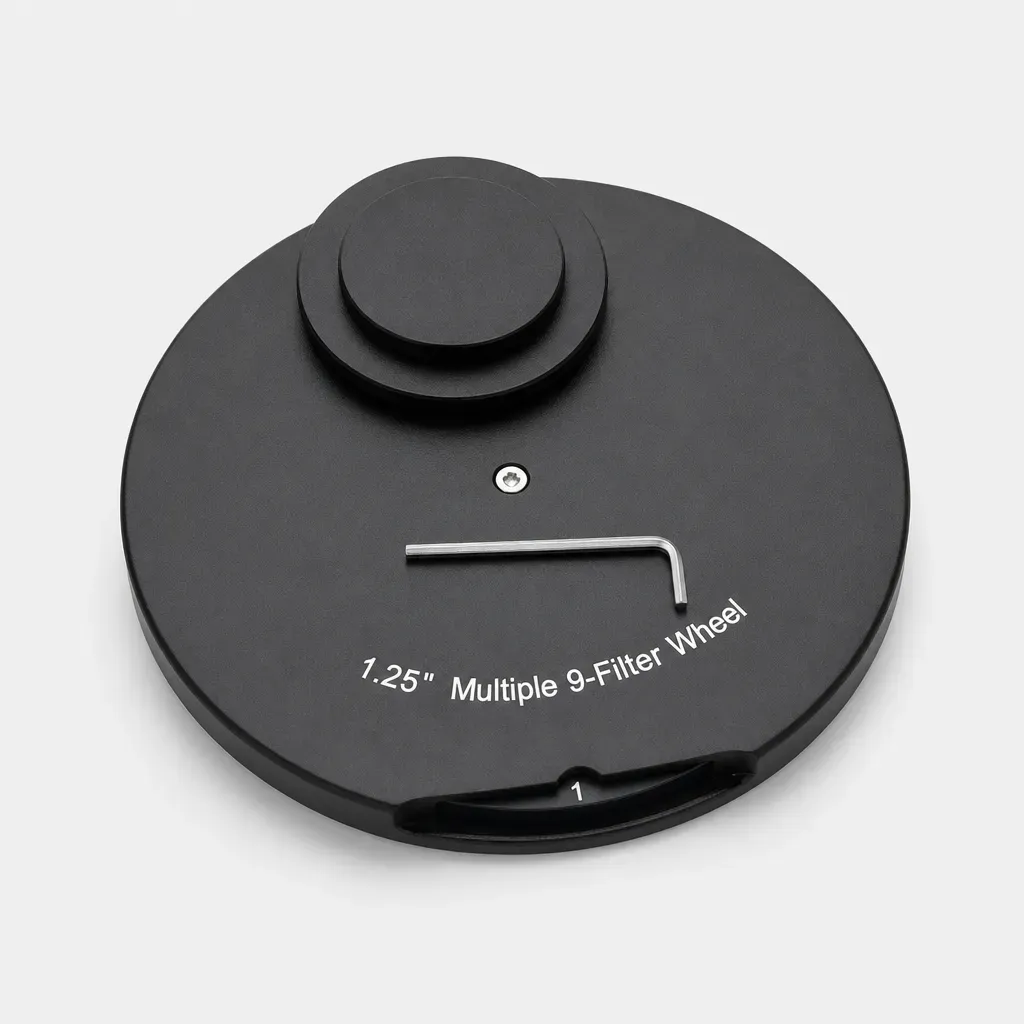
TL;DR: A 9 position 1.25 inch filter wheel is an automated, motorized astronomical carousel that holds up to nine standard 1.25-inch optical filters in a sealed, light-tight housing. By housing a complete set of LRGB broadband, SHO narrowband, dark frame, and specialty filters simultaneously, it eliminates the need to manually open your optical train. Consequently, UK astrophotographers can maximize unpredictable clear skies with automated, uninterrupted sequence shooting via ASCOM or N.I.N.A.
A 9 position 1.25 inch filter wheel is an automated optical accessory designed to hold nine individual mounted 1.25-inch optical filters within a motorized, light-tight internal carousel for seamless, remote-controlled filter swapping. Mounted directly between a telescope's focuser and an imaging camera, this device allows astrophotographers to alternate between mono broadband, narrowband, and calibration modes without dismantling their gear.
For UK-based astrophotographers, clear skies are an exceedingly scarce commodity. According to observational weather summaries from the British Astronomical Association (BAA), the UK experiences an average of just 35 to 50 fully clear nights per year across most regions—with coastal and northern areas suffering even lower yields due to persistent Atlantic cloud fronts. Therefore, when an unexpected clear window arrives between cloud banks, every minute spent re-balancing a mount, unscrewing light-train adapters, or wiping dew off individual filters is precious observation time lost.
Based on our testing at PositFilter Optics, transitioning from manual filter drawers or smaller 5-position wheels to a dedicated 9 position 1.25 inch filter wheel fundamentally streamlines your imaging cadence. By accommodating a complete suite of broadband LRGB filters alongside narrowband emission filters and specialized planetary optics within a single sealed housing, you effectively remove physical intervention from your night-time routines. Ultimately, this guide breaks down the mechanics, optical considerations, vignetting profiles, and setup requirements of 9-position 1.25-inch filter wheels, helping UK astronomers make an informed upgrade for uninterrupted stargazing.
What Is a 9 Position 1.25 Inch Filter Wheel and How Does It Work?
A 9 position 1.25 inch filter wheel mounts directly into the optical path between a telescope's focuser (or field flattener/reducer) and an astronomical imaging camera. Inside the wheel's CNC-machined aluminum housing sits a high-precision internal carousel engineered with nine threaded cells designed to hold standard 1.25-inch mounted filters (M28.5x0.6 thread pitch).
The carousel is driven by an internal micro-stepping motor coupled with an optical index encoder. When controlled via imaging software, the carousel rotates smoothly to place the selected filter directly over the camera sensor with sub-millimetre positional repeatability. Furthermore, high-grade units feature ultra-thin profiles—typically adding only 20mm to 24mm of back-focus distance—ensuring full compatibility with sensitive focal reducers and standard optical train tolerances.
Why Choose 1.25 Inch Filters Over 2 Inch Filters?
While 2-inch and 36mm unmounted filters have gained popularity for full-frame sensors, mounted 1.25-inch optical filters remain the preferred, cost-effective choice for mainstream astrophotographers operating sensors up to the Micro Four Thirds (M4/3) format, as well as popular planetary sensors (such as the Sony IMX585, IMX678, and IMX533). Mounted 1.25-inch filters offer several practical benefits:
- Standardised Threading: Standard M28.5x0.6 threads allow cross-compatibility between visual accessories, eyepieces, and digital imaging hardware.
- Physical Protection: The metal cell rim protects glass substrates during installation, dramatically reducing the risk of accidental finger grease or chip damage.
- Cost Efficiency: Precision glass coating procedures cost exponentially more as surface area increases. Consequently, 1.25-inch optical filters offer high transmission rates and steep spectral cut-offs at a fraction of the cost of 2-inch glass.
Why Are 9 Filter Positions a Game-Changer for Astrophotographers?
Historically, standard motorized filter wheels provided 5 or 7 positions. While a 5-position wheel holds standard LRGB filters plus a single light pollution filter, and a 7-position unit holds LRGB + SHO (H-alpha, OIII, SII), both configurations require physical modification when swapping between different imaging targets. In contrast, a 9 position 1.25 inch filter wheel breaks through this limitation by housing every primary imaging filter you need in one permanently configured carousel.
What Filters Should You Put in a 9 Position Filter Wheel?
Based on our testing across various imaging setups, astrophotographers can permanently mount a complete hybrid toolkit for planetary, deep-sky mono, and calibration routines in the following recommended loadout:
- Luminance (L): UV/IR-cut filter for broadband detail capture.
- Red (R): True-colour broadband spectrum.
- Green (G): Broadband colour synthesis.
- Blue (B): Broadband colour synthesis.
- Hydrogen-Alpha (Hα): 3nm or 7nm narrowband filter for target emission nebulae.
- Oxygen-III (OIII): 3nm or 7nm narrowband filter for planetary nebulae and supernova remnants.
- Sulfur-II (SII): 3nm or 7nm narrowband filter to complete the Hubble Palette (SHO).
- Dark / Opaque Filter: Solid optical blank for taking automated dark frames and bias frames without covering the telescope tube.
- Specialty / Light Pollution Filter: A dedicated IR-Pass filter (e.g., IR-685) for planetary detail under turbulent skies, or a city-light cut filter (e.g., Neodymium/CLS) for deep-sky imaging under urban Bortle 7–8 light pollution.
"In UK astrophotography, weather transitions happen within minutes. Having both LRGB and narrowband filters loaded in a single 9-position housing means you can switch from LRGB imaging on bright galaxies to Hα narrowband on emission targets the moment light pollution or moonlight interferes, without interrupting your session."
Mechanical Precision & Optical Performance in UK Conditions
Operating optical equipment outdoors in the UK presents distinct environmental challenges. High relative humidity—often exceeding 85% on spring and autumn nights—creates rapid dew formation, while temperature drops cause metal thermal contraction that affects mechanical alignment.
1. Light-Tight Seals & Moisture Control
A well-engineered 9 position 1.25 inch filter wheel utilizes precision O-ring gaskets or light-tight labyrinth seals along its outer casing. As a result, damp nighttime air and stray street lighting are prevented from entering the camera optical path, preserving contrast and shielding glass surfaces from condensation buildup during extended sessions.
2. Vignetting Expectations for Standard Sensors
According to optical testing guidelines for fast focal ratios, mounted 1.25-inch filters positioned within 10mm to 15mm of the camera sensor frame deliver fully unvignetted light cones on sensors up to 1-inch formats (e.g., IMX533) even at f/4. For Micro Four Thirds sensors (e.g., IMX294), minor flat-field calibration fully corrects light drop-off at the extreme corners, ensuring flawless optical performance.
How Do You Set Up a 9 Position Filter Wheel with ASCOM and N.I.N.A.?
Integrating your filter wheel into automated control suites is straightforward thanks to standardized astronomical driver protocols. In addition, native USB connectivity allows plug-and-play operation across Windows, macOS, and Linux platforms.
- ASCOM / INDI Integration: Install the manufacturer's ASCOM driver on Windows or INDI driver on StellarMate/ASIAIR systems. Assign filter names and offsets to each slot (1 through 9).
- Focus Offset Calibration: Because different filter glass thicknesses cause slight shifts in focal point, software platforms like N.I.N.A. or Ekos allow you to save specific focus offsets per filter slot, triggering micro-adjustments on your electronic focuser automatically upon switching slots.
- Automated Sequences: Program multi-target imaging sequences that automatically execute LRGB captures during dark sky windows and switch to narrowband slots when the moon rises, maximizing overall data yield per night.
Frequently Asked Questions
What sensors work best with a 9 position 1.25 inch filter wheel?
1.25-inch filter wheels work seamlessly with planetary sensors and deep-sky mono sensors up to Micro Four Thirds (M4/3) formats, including popular options such as the Sony IMX533, IMX585, IMX678, and IMX294 without severe vignetting.
Does a 9 position filter wheel require external power cables?
In most modern designs, the low-draw micro-stepping motor is powered directly via USB 2.0 bus power from your main imaging camera's built-in USB hub or mini PC, keeping your cable management clean and streamlined.
Can I use unmounted glass filters in a threaded 1.25 inch filter wheel?
Threaded 1.25-inch filter wheels require cell-mounted filters featuring standard M28.5x0.6 male threads. If you intend to use unmounted glass substrates, dedicated 31mm or 36mm filter carousels are recommended instead.
Ready to upgrade your optical setup with PositFilter Optics?
Shop Now — £85.99