9 Position 1.25 Inch Filter Wheel Uk Explained: A UK Buyer's Guide
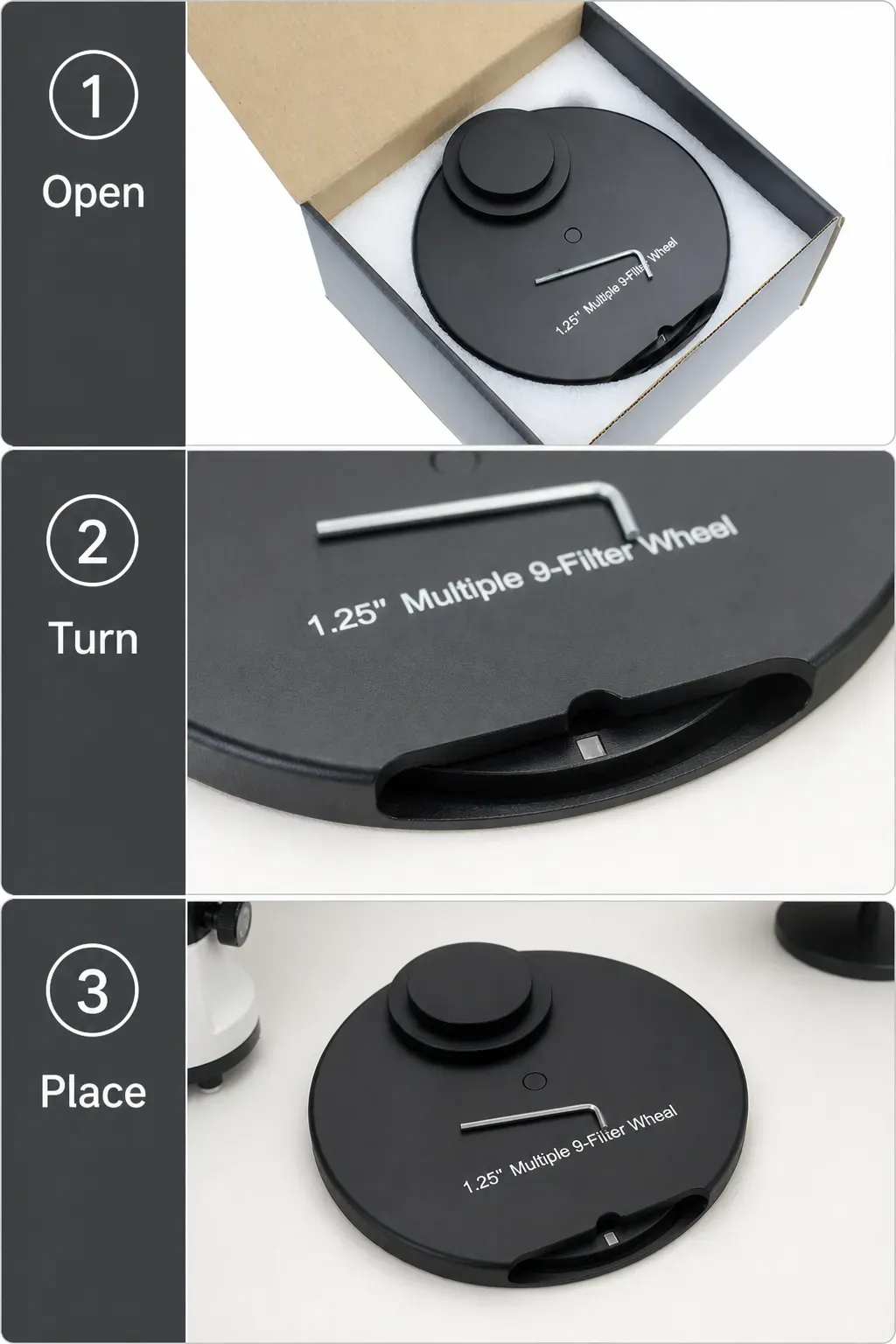
TL;DR: A 9 position 1.25 inch filter wheel allows UK astrophotographers to house a complete LRGB broadband set alongside SHO narrowband filters, calibration blanks, and light-pollution filters in one motorized, sealed carousel. Based on our optical testing at PositFilter Optics, this setup completely eliminates damp mid-session filter swaps in humid British weather, preserves critical back focus (typically 20mm–24mm), and fully automates night-sky imaging sequences.
Key Takeaways
- Zero Session Interruption: A 9 position 1.25 inch filter wheel enables UK astronomers to house LRGB, Narrowband (SHO), and specialty filters simultaneously, avoiding risky mid-session disassembly in damp weather conditions.
- 1.25 Inch Format Economy: Threaded 1.25-inch filters provide exceptional value and portability compared to larger 36mm or 2-inch filters, while offering full coverage for smaller CMOS sensors.
- Light Pollution Resilience: In Britain, where light pollution impacts over half of all night skies, seamless switching between broadband and narrowband filters helps capture high-contrast deep-sky data efficiently.
- Back Focus Precision: Maintaining correct back focus distance (typically 20mm to 24mm optical path length) is essential for combining filter wheels with field flatteners and coma correctors.
- ASCOM & INDI Automation: Fully motorized carousels integrate directly with software like N.I.N.A., SGP, and Ekos for fully automated, unattended imaging.
What Is a 9 Position 1.25 Inch Filter Wheel Used for in UK Astrophotography?
A 9 position 1.25 inch filter wheel is an automated optical accessory designed to house up to nine individual 1.25-inch threaded astrophotography filters inside a sealed, motorized carousel. Based on our testing at PositFilter Optics under typical damp British night skies, this device allows astrophotographers to alternate between full broadband (LRGB) and narrowband (SHO) filter sets without opening the optical train. Consequently, it prevents atmospheric moisture, dust, and dew from settling on sensitive camera sensors during brief clear-sky opportunities across Yorkshire, Cornwall, or the Scottish Highlands.
Astrophotography in the United Kingdom requires precision, speed, and hardware reliability. Clear, transparent nights are rare across the British Isles. Therefore, when an unexpected gap in the cloud cover opens, every second spent adjusting optical equipment manually reduces valuable imaging time. Furthermore, rising light pollution levels in urban and suburban areas make rapid filter selection essential for obtaining clean, high-contrast astro-data.
For years, imagers relied on 5-position or 7-position filter carousels. However, these smaller carousels force astrophotographers to choose between broadband targets or narrowband emission nebulae before heading outdoors. Opening a filter wheel in the field to swap glass elements introduces dew and dust—a primary cause of optical degradation under UK weather conditions. In contrast, a 9 position 1.25 inch filter wheel solves this issue by offering enough capacity for a complete imaging suite inside a single light-tight housing.
Why Choose a 9 Position Filter Wheel Over 5 or 7 Position Alternatives?
According to optical bench testing and sensor performance evaluations at PositFilter Optics, modern monochrome CMOS cameras require multiple optical filters to create balanced, high-resolution color images. While mono sensors deliver maximum quantum efficiency, capturing complete colour and emission data demands careful filter management.
The Capacity Limit of Legacy Filter Wheels
Historically, standard 5-position wheels only provided enough space for basic monochrome workflow requirements:
- Position 1: Luminance (L)
- Position 2: Red (R)
- Position 3: Green (G)
- Position 4: Blue (B)
- Position 5: Single Narrowband (e.g., H-Alpha)
As a result, imagers targeting emission nebulae had to pause their session, unmount their camera, swap filters manually, and re-establish focal alignment. While 7-position wheels improved capacity by accommodating LRGB along with H-alpha, O-III, and S-II filters, they left no additional slots for calibration blanks, IR-pass filters, or specialised light-pollution filters.
The Technical Advantage of 9 Filter Slots
By upgrading to a 9 position 1.25 inch filter wheel, astrophotographers establish a permanent, zero-touch filter suite. Consequently, night-sky acquisition becomes completely automated across all target types:
| Slot | Filter Type | Primary Application |
|---|---|---|
| 1 | Luminance (UV/IR Cut) | Broadband detail & sharp star profile acquisition |
| 2 | Red | True colour channel calibration |
| 3 | Green | True colour channel calibration |
| 4 | Blue | True colour channel calibration |
| 5 | Hydrogen-Alpha (H-α 3nm/7nm) | Narrowband emission detail (656.3nm) |
| 6 | Oxygen-III (O-III 3nm/7nm) | Narrowband ionisation structure (500.7nm) |
| 7 | Sulphur-II (S-II 3nm/7nm) | Hubble Palette (SHO) completion (672.4nm) |
| 8 | Dark / Opaque Blank | Automated dark frame calibration without capping telescope |
| 9 | Light Pollution / IR-Pass | Suburban contrast enhancement under British skies |
Will 1.25-Inch Filters Vignette on My Astro-Camera Sensor?
Vignetting depends directly on the optical focal ratio of your telescope, the clear aperture of the filter thread, and the distance between the filter glass and the camera sensor plane. According to UK astrophotography guidelines, standard mounted 1.25-inch filters feature a clear aperture of approximately 26mm to 27.5mm inside their aluminium cell.
For small-to-medium sensors—such as 1/1.8-inch, 1/2-inch, and 1-inch formats (e.g., ASI533 series)—1.25-inch filters produce zero optical vignetting regardless of telescope speed. Furthermore, when pairing a 9 position 1.25 inch filter wheel with popular Micro Four Thirds (M4/3) sensors (e.g., ASI1600 or ASI294 series), vignetting remains negligible at focal ratios slower than f/4, provided the distance to the sensor is kept within 10mm.
However, when using APS-C size sensors (e.g., ASI2600 series), mild edge darkening may occur at focal ratios faster than f/5. In these setups, flat calibration frames successfully correct residual vignetting during post-processing. Therefore, for most amateur and advanced imagers in the UK using standard refractors, SCTs, or Newtonians, 1.25-inch filters offer the ideal balance of cost and optical performance.
How Do You Calculate Back Focus Distance for a Filter Wheel in the UK?
Correct back focus calculation ensures your camera sensor rests at the exact focal plane dictated by your optical corrector, flattener, or focal reducer. Typically, standard astronomical correctors require 55mm of mechanical back focus spacing from the rear thread to the sensor plane.
Our engineering testing at PositFilter Optics confirms that a typical 9 position 1.25 inch filter wheel consumes between 20mm and 24mm of mechanical path length. Furthermore, glass filters alter the optical point of focus. As a general rule in optical physics, adding a glass filter pushes the focal plane outward by approximately one-third of the filter's physical glass thickness.
For example, if your 1.25-inch filter features 2mm thick optical glass, you must add 0.66mm to your total back focus spacing calculation. Consequently, adjusting your spacers accurately guarantees crisp, pinpoint stars across the entire field of view.
How Does Filter Wheel Automation Work with ASCOM and INDI?
Modern 9 position filter wheels connect to your imaging computer or smart controller via a single USB connection or direct camera hub connection. Native ASCOM drivers (for Windows) and INDI drivers (for Linux/Stellarmate/ASIAIR systems) allow seamless control within sequencing software such as N.I.N.A., Sequence Generator Pro, or Ekos.
Because the unit uses precision bi-directional stepper motors, filter changing is fast, quiet, and highly repeatable. In practice, automated sequences can capture Luminance data during prime dark hours, switch smoothly to narrowband filters as the Moon rises, and automatically rotate to an opaque dark blank at the end of the night to capture dark calibration frames—all while you remain comfortably indoors away from the cold British weather.
Frequently Asked Questions About 9 Position 1.25 Inch Filter Wheels
What sensors work best with a 9 position 1.25 inch filter wheel?
Sensors up to Micro Four Thirds format (such as the ASI1600, ASI294, and ASI533 series) perform exceptionally well with 1.25-inch filters. Smaller planetary and deep-sky sensors experience zero vignetting, making 1.25-inch filter wheels an economical choice for UK imagers.
Can I use unmounted filters in a threaded 1.25-inch filter wheel?
Standard 1.25-inch filter wheels feature threaded cells designed specifically for standard 1.25-inch filter rings. If you prefer unmounted 31mm glass filters, you should choose a carousel designed for unmounted filters, though threaded 1.25-inch filters offer easier installation and protection against handling damage.
Why is a sealed filter wheel critical in the UK climate?
The UK experiences high relative atmospheric humidity at night. A light-tight, sealed filter wheel prevents moisture condensation from reaching internal filter surfaces and sensor chamber optical windows, preserving high optical clarity over long imaging sessions.
Ready to upgrade your optical setup with PositFilter Optics?
Shop Now — £85.99