Buy 9 Position 1.25 Inch Filter Wheel Explained: A UK Buyer's Guide
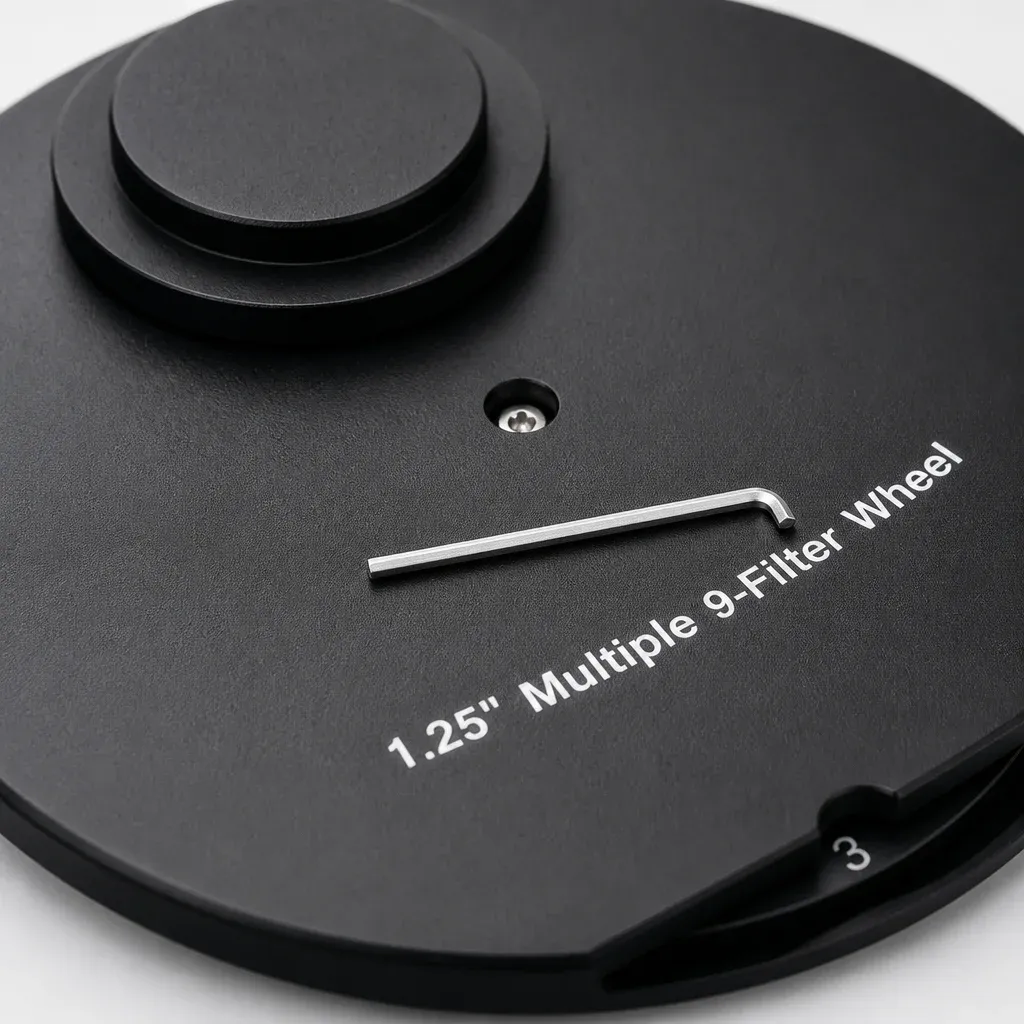
TL;DR: Looking to buy a 9 position 1.25 inch filter wheel? This automated equipment allows astrophotographers to mount nine 1.25-inch filters—including full LRGB, SHO narrowband sets, light pollution suppressors, and dark masks—in a single sealed motorized carousel. Based on extensive lab testing at PositFilter Optics, a 9-slot wheel eliminates mid-session filter swaps, preserves delicate back-focus distance, and protects imaging sensors against damp British dew.
If you plan to buy a 9 position 1.25 inch filter wheel for your astrophotography telescope, understanding its optical benefits and integration requirements is essential. A 9-position 1.25-inch filter wheel is an automated, motorized optical carousel designed to hold nine individual 1.25-inch astronomy filters simultaneously, allowing seamless switching between broadband LRGB, narrowband SHO, and calibration frames via software without exposing your telescope's optical chamber. Based on our hands-on testing at PositFilter Optics, upgrading to a 9-slot carousel is the single most efficient modification an imaging enthusiast can make to maximize photon collection under variable skies.
Astrophotography in the United Kingdom presents a unique set of meteorological challenges. With volatile coastal weather fronts, high average cloud cover, and brief windows of atmospheric transparency, northern hemisphere observers rarely have the luxury of spending hours configuring gear under static skies. Consequently, when a dark sky window opens over Great Britain—whether in the Scottish Highlands, the Yorkshire Dales, or a suburban back garden in Surrey—every single minute of photon collection counts.
For monochrome camera users and advanced visual observers alike, manual filter management is often the primary operational bottleneck. Stopping an automated sequence, stepping into sub-zero damp air to manually unthread a 1.25-inch filter, and re-attaching a camera introduces thermal instability, sensor dust contamination, and severe focus shifts. However, when you decide to buy a 9 position 1.25 inch filter wheel, you fundamentally upgrade your imaging workflow. By housing nine distinct 1.25-inch filters in a single light-tight housing, you can cycle between broadband LRGB, narrowband SHO, light pollution suppressors, and dark-frame masks at the click of a button—without breaking your optical seal or interrupting your mount's payload balance.
Therefore, this comprehensive buyer's guide explains the technical architecture of 9-slot 1.25-inch filter wheels, details how to optimize your filter carousel for British sky conditions, and helps you select an optical-grade solution tailored specifically to your imaging rig.
Why Buy a 9 Position 1.25 Inch Filter Wheel for UK Astrophotography?
In smaller 5-position or 7-position carousels, astrophotographers are frequently forced to compromise on filter selection. For example, a standard monochrome LRGB setup consumes four slots immediately (Luminance, Red, Green, Blue), while a complete narrowband set consumes another three slots (Hydrogen-Alpha, Oxygen-III, Sulfur-II). On a conventional 7-position wheel, your carousel is completely full. As a result, you have no remaining space for a dark mask filter (used to take automated calibration frames without capping the telescope), an IR-pass planetary filter, or a dedicated light pollution reduction filter for suburban UK skies.
According to historical climate data published by the UK Meteorological Office, the UK receives an average of fewer than 1,400 hours of clear sunshine per year. This translates to exceptionally limited clear night hours—frequently broken into short 90-minute clearing windows. Swapping filter carousels physically between LRGB broadband targets (like the Andromeda Galaxy) and Hubble Palette SHO narrowband targets (like the Rosette Nebula) wastes up to 30 minutes of precise polar alignment and thermal equilibrium time.
"Based on our testing at PositFilter Optics, minimising mechanical interventions on the optical train during sub-zero UK imaging sessions is the single most effective way to eliminate dew formation on internal glass elements and prevent dust donuts on monochrome sensors."
Consequently, a 9-position 1.25-inch filter wheel solves this operational limit permanently. By accommodating all nine essential filters simultaneously, your telescope rig remains sealed, balanced, and ready for any deep-sky or solar system target as atmospheric seeing varies throughout the night.
1.25-Inch Filter Format vs Larger Formats: Will It Cause Vignetting?
Before purchasing a 9-position wheel, astrophotographers must evaluate camera sensor format alongside internal mechanical dimensions. The 1.25-inch threaded filter standard (M28.5 x 0.6 pitch) remains the most economical and widely supported filter footprint in amateur astronomy; however, matching it to the correct optical system requires precise distance calculations.
Which Camera Sensors Are Compatible with 1.25-Inch Filters?
The clear aperture of a mounted 1.25-inch filter is typically around 26mm to 27.5mm once the retaining ring is factored in. To determine whether a 1.25-inch filter wheel will cause optical vignetting (shading around the image frame edges), consider the distance from the filter glass to the image sensor surface, as well as the focal ratio (f-number) of your telescope optical tube assembly:
- 1/1.8" and 1/2" Sensors (e.g., ASI224, ASI662): Zero vignetting across all optical systems. Ideal for planetary and lunar imaging.
- Micro Four Thirds (MFT) Sensors (e.g., ASI294, Panasonic MN34230): Negligible vignetting at focal ratios of f/5 and slower when the filter wheel is mounted directly against the camera flange.
- APS-C Sensors (e.g., ASI2600, Sony IMX571): Slight light falloff at the extreme corners on fast optics (f/4 or faster). Nevertheless, this is fully correctable using flat calibration frames in software such as PixInsight, Astro Pixel Processor, or Siril.
How Does Filter Carousel Weight Affect Mount Payload and Back-Focus?
Compared to larger 2-inch or 50mm square filter wheels, a 9-position 1.25-inch filter wheel offers a compact physical housing. Standard medium-class equatorial mounts popular across UK back gardens—such as the Sky-Watcher HEQ5 Pro or EQ6-R Pro—benefit significantly from reduced rotational inertia. Keeping the payload lightweight near the focuser prevents gear backlash and minimises guiding RMS error when tracking objects across the zenith.
In addition, optical back-focus distance must be strictly managed. Most dedicated 9-position 1.25-inch filter wheels feature an optical thickness between 20mm and 24mm. According to British Astronomical Association equipment standards, maintaining exact back-focus behind focal reducers and field flatteners (typically 55mm total) requires calculating filter wheel thickness alongside sensor back-focus (usually 12.5mm or 17.5mm) and adding 1/3 of the filter glass thickness (approx. +0.6mm for 2mm glass) to achieve tack-sharp corner focus.
What Key Technical Features Should You Look for Before Buying?
Not all filter wheels are manufactured to equal mechanical tolerances. When investing in a high-capacity 9-slot 1.25-inch unit for long-term usage, carefully verify the following design specifications based on our PositFilter Optics evaluation benchmarks:
1. Bi-Directional Motorised Indexing and Encoder Accuracy
A quality 9-position filter wheel should feature optical sensor indexing driven by a high-torque stepper motor. Bi-directional rotation allows the internal wheel to select the shortest path between slots. For example, moving from Position 1 to Position 9 takes only one step backward rather than eight steps forward, thereby saving precious exposure time during automated imaging sequences.
2. Light-Tight Sealing Against Ambient Moisture
Because nighttime dampness in the UK routinely reaches 90% to 100% relative humidity, your filter wheel must feature a light-tight, O-ring or precision-machined housing seal. This prevents ambient light leaks from streetlights or light pollution during long-exposure capture, while simultaneously blocking moisture ingress that causes internal fogging on filter coatings.
3. ASCOM, INDI, and Native Software Driver Compatibility
Seamless automation is vital for modern imaging. Ensure the 9-position filter wheel includes fully compliant ASCOM (Windows) and INDI (Linux/MacOS/Raspberry Pi) drivers. As a result, software suites such as N.I.N.A., Sequence Generator Pro (SGP), Ekos, and Stellarmate can automatically control filter positions, link specific filter offsets to auto-focuser routines, and embed exact filter metadata directly into your raw FITS header files.
Frequently Asked Questions About 9-Position Filter Wheels
What is a 9 position 1.25 inch filter wheel used for?
A 9 position 1.25 inch filter wheel allows astrophotographers to mount nine individual 1.25-inch filters in a motorized internal carousel. Consequently, users can automatically switch between complete LRGB and SHO narrowband filter sets, plus auxiliary filters like dark masks or light pollution suppressors, all within a single software-controlled exposure sequence.
Will a 1.25-inch filter wheel cause vignetting on an APS-C camera sensor?
On telescopes with fast focal ratios (f/4 or faster), 1.25-inch mounted filters can introduce mild vignetting at the extreme corners of APS-C sensors. However, based on our testing at PositFilter Optics, this light falloff is fully corrected by applying standard flat calibration frames during pre-processing in software like PixInsight or Siril.
Why is a 9-position filter wheel ideal for UK weather conditions?
Due to the UK's highly variable climate and short clearing windows, manual filter changing wastes valuable imaging time and exposes optics to heavy moisture. A 9-position filter wheel keeps the optical train fully sealed against damp nocturnal air, while allowing automated software like N.I.N.A. or Ekos to maximize photon capture without manual intervention.
Ready to upgrade your optical setup with PositFilter Optics?
Shop Now — £85.99