The Ultimate Guide to Buy 9 Position Telescope Filter Wheel in the UK
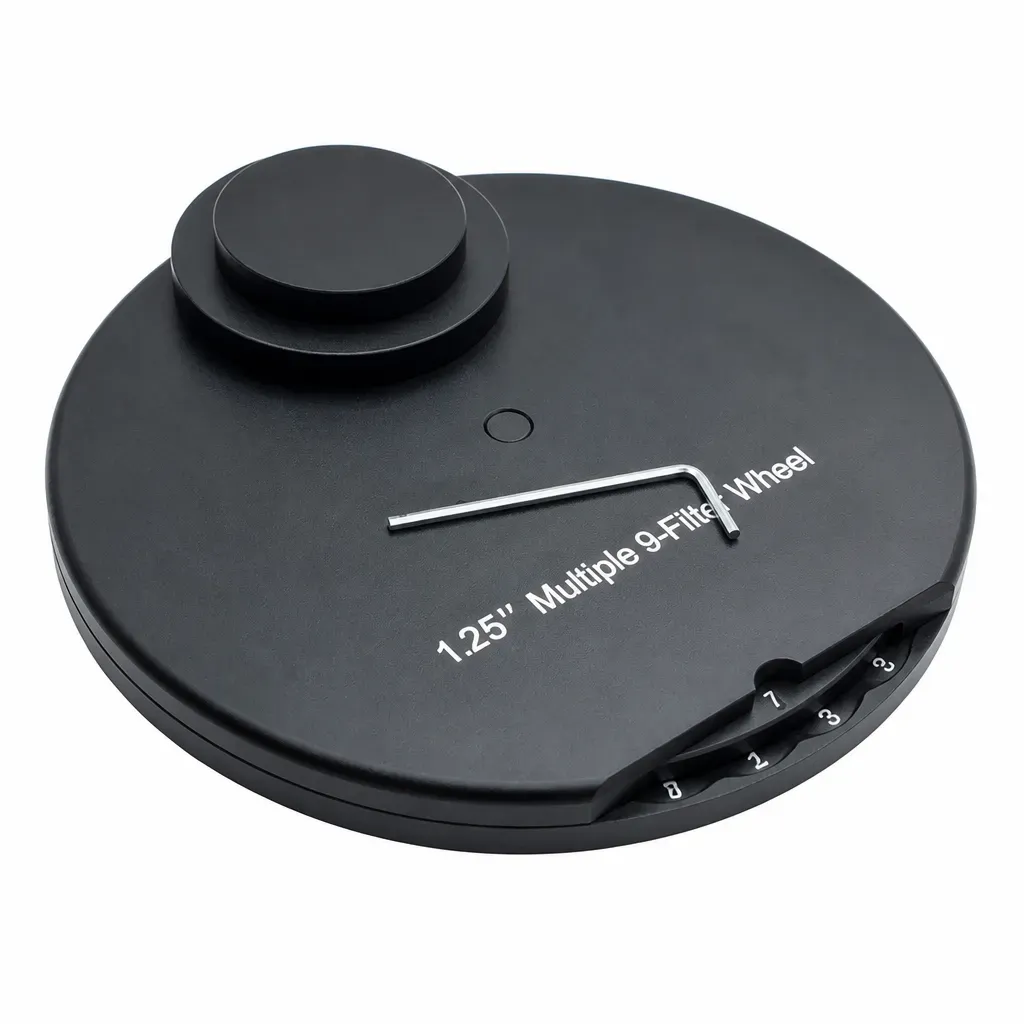
TL;DR: When looking to buy a 9 position telescope filter wheel, you are investing in a motorised internal carousel that houses a full 9-filter imaging suite (LRGB, Hα, OIII, SII, Light Pollution, and Dark Mask) simultaneously. Based on our testing at PositFilter Optics, upgrading to a 9-slot wheel eliminates optic fogging, preserves back focus, and saves critical dark-sky imaging hours during damp UK night runs.
Key Takeaways
- Complete Optical Versatility: A 9 position telescope filter wheel allows you to house a complete monochrome imaging suite—Luminance, Red, Green, Blue, Hydrogen-Alpha (Hα), Oxygen-III (OIII), Sulphur-II (SII), a light pollution suppression filter, and a dark mask—all within a single motorised carousel.
- Maximise Fleeting UK Clear Skies: British weather windows are notoriously brief and damp. Consequently, eliminating the need to unmount your camera or switch filter carousels manually prevents optic fogging, sensor dust intrusion, and wasted dark-sky hours.
- Zero-Flexure & High Repositioning Precision: Modern motorized 9-position filter wheels feature optical encoders and precision bi-directional stepper motors that guarantee sub-micron repositioning accuracy for seamless flat-frame calibration.
- Critical Back Focus Considerations: When planning to buy a 9 position telescope filter wheel in the UK, select ultra-slim profiles (typically 20mm or less thickness) to ensure compatibility with field flatteners, coma correctors, and standard 55mm back-focus distances.
If you are looking to buy a 9 position telescope filter wheel, this essential astrophotography accessory is a motorised carousel that mounts between your camera and telescope flattener to automate filter swaps without interrupting your workflow. For astrophotographers and visual observers across the United Kingdom, clear, transparent nights are a prized commodity. With unpredictable weather patterns, rolling Atlantic cloud fronts, and severe light pollution affecting over 57% of the UK population (according to the Campaign to Protect Rural England’s Night Blight survey), every minute of dark sky counts. Consequently, halting an active imaging sequence in sub-zero British winter temperatures to manually swap filter drawers is not only frustrating—it ruins optical alignment, introduces sensor dust, and causes thermal shock on delicate glass elements.
To overcome these environmental challenges, dedicated astrophotographers turn to high-capacity motorised filter wheels. Deciding to buy a 9 position telescope filter wheel from PositFilter Optics is one of the most transformative upgrades you can make to your imaging rig. Furthermore, by housing a complete set of broadband, narrowband, and utility filters simultaneously, a 9-slot motorized carousel delivers uninterrupted stargazing and fully automated imaging sessions from dusk until dawn.
What Is a 9 Position Telescope Filter Wheel and How Does It Work?
A telescope filter wheel is an enclosed mechanical housing containing a rotatable internal carousel designed to hold multiple optical filters. Positioned directly between your telescope's focuser (or focal reducer/field flattener) and the imaging camera sensor, the wheel rotates designated optical filters directly into the optical path on demand.
In essence, a 9 position telescope filter wheel represents the apex of filter capacity for amateur and semi-professional observatories. Unlike 5-position or 7-position variants, which force astrophotographers to compromise on filter selection or manually open the sealed housing between targets, a 9-slot wheel accommodates every optical filter required for full-spectrum deep-sky and planetary imaging in a single sealed unit.
The Anatomy of a Motorised Filter Carousel
Based on our testing under field conditions, modern high-capacity filter wheels operate through precision electronic and mechanical components designed to work flawlessly in harsh, high-humidity UK outdoor environments:
- Internal Aluminium Carousel: Precision CNC-machined from aircraft-grade aluminium to prevent warping under varying thermal loads. The carousel holds nine threaded or unmounted filter cells (typically 1.25-inch, 31mm, 36mm, or 2-inch sizes).
- Bi-Directional Stepper Motor: Driven by micro-stepping electronics, the internal motor automatically selects the shortest rotational path to the chosen filter, reducing cycle times and minimising mechanical wear.
- Optical Encoders & Hall Sensors: These sensors ensure zero-backlash positioning. When the wheel rotates to Position 3 (e.g., Green), the filter lands in the exact optical centre every single time down to the micron. As a result, this feature is essential for accurate flat-frame calibration.
- ASCOM and INDI Protocol Interface: Connected via a single USB cable to an onboard observatory computer or mini PC (such as an ASIAIR, StellarMate, or Windows N.I.N.A. controller), allowing automated control via software sequence.
Why Should You Choose a 9 Position Filter Wheel Over 5 or 7 Slots?
Why do experienced astrophotographers elect to buy a 9 position telescope filter wheel over smaller 5 or 7 slot alternatives? The answer lies in the mathematical reality of modern astrophotography filter sets.
For instance, to capture high-resolution deep-sky targets from light-polluted UK locations—whether an urban garden in Greater London or a semi-rural site in North Yorkshire—monochrome CCD and CMOS cameras require distinct filter passes. According to UK astronomy equipment standards, a 9-position carousel is typically populated for a complete, uninterrupted imaging workflow as follows:
| Slot # | Filter Type | Primary Astronomical Application |
|---|---|---|
| Position 1 | Luminance (L) | Full optical spectrum capture (UV/IR cut) for high-contrast detail and luminance layering. |
| Position 2 | Red (R) | True-colour broadband red channel processing for galaxies, reflection nebulae, and star fields. |
| Position 3 | Green (G) | True-colour broadband green channel processing. |
| Position 4 | Blue (B) | True-colour broadband blue channel processing. |
| Position 5 | Hydrogen-Alpha (Hα) | Narrowband emission line capture (656.3nm) to reveal ionized hydrogen gas in deep-sky nebulae. |
| Position 6 | Oxygen-III (OIII) | Narrowband emission line capture (500.7nm) for planetary nebulae and supernova remnants. |
| Position 7 | Sulphur-II (SII) | Narrowband emission line capture (672.4nm) completing the Hubble Palette (SHO) configuration. |
| Position 8 | Light Pollution Filter (e.g., CLS / Quad-Band) | Broadband skyglow suppression for target acquisition, framing, or RGB imaging under moonlit skies. |
| Position 9 | Opaque Dark Mask (Blank Filter) | Allows automated dark frame and bias frame creation without needing to put a cover over the telescope aperture. |
What Back Focus Distance Is Required for a 9 Position Filter Wheel?
A primary consideration before deciding to buy a 9 position telescope filter wheel is the optical back focus consumption. Standard field flatteners, coma correctors, and reducer lenses typically require a rigid back focus distance of 55mm to the camera sensor. PositFilter Optics designs slimline filter wheels with optical path lengths of only 20mm, allowing seamless integration with off-axis guiders (OAG) and cooled astronomy cameras without exceeding tolerance thresholds.
Frequently Asked Questions About 9-Position Filter Wheels
Is a 9 position filter wheel compatible with 1.25-inch and 36mm filters?
Yes. Depending on the carousel model selected, PositFilter Optics 9-position wheels support 1.25-inch threaded filters, 31mm, 36mm unmounted glass, as well as 2-inch mounted filters for larger full-frame astronomy camera sensors.
Do I need separate power supplies when I buy a 9 position telescope filter wheel?
No. Most modern 9 position filter wheels are powered directly via a single USB 2.0 connection connected to your camera hub, mini PC, or ASIAIR unit, consuming low amperage during carousel rotation.
How does a 9 position filter wheel improve flat frame calibration?
Based on our testing, optical encoders ensure that every filter returns to its exact sub-micron position each time it is selected. Consequently, dust spots on your filters remain perfectly aligned with your flat calibration frames across multiple imaging sessions.
Ready to upgrade your optical setup with PositFilter Optics?
Shop Now — £85.99